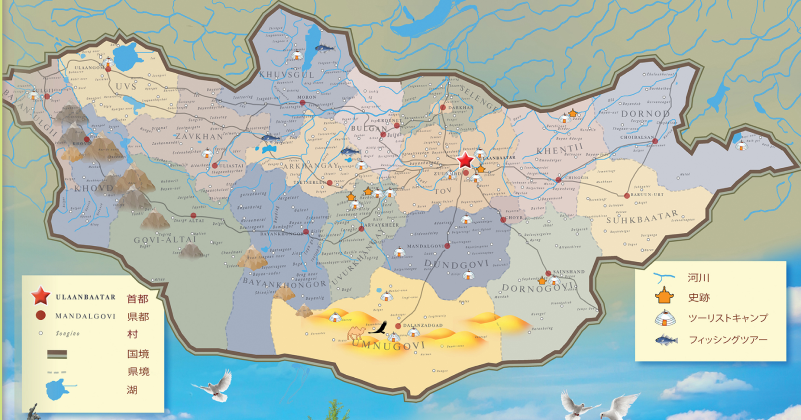
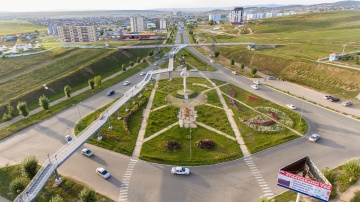
The history of Darkhan-Uul Province is fundamentally tied to northern Mongolia’s rapid industrialization in the mid-20th century. On October 17, 1961, construction began on the region's main urban center, Darkhan City, in the fertile Kharaa River valley to alleviate population pressure on Ulaanbaatar and establish a heavy industrial foundation. Developed with extensive financial, architectural, and technical aid from Soviet bloc Comecon nations, the city quickly grew into a manufacturing stronghold for concrete, steel, textiles, and food processing. To better integrate the expanding urban core with its surrounding agricultural territory, the Mongolian parliament officially carved Darkhan-Uul Province out of Selenge Province in 1994, organizing it into four main administrative units (sums): Darkhan, Khongor, Orkhon, and Sharyngol.
Geographically and demographically, Darkhan-Uul is one of Mongolia’s most densely populated and compact administrative regions. Spanning an area of $3,275\text{ km}^2$ along the main Trans-Mongolian Railway line about 230 km north of Ulaanbaatar, the province houses roughly 105,000 to 110,000 residents, with over 80% concentrated directly in Darkhan City. Despite its heavily urbanized population, the surrounding rural districts leverage the region’s relatively mild, low-elevation climate to serve as one of the nation's premier agricultural breadbaskets, yielding significant wheat, potato, and vegetable harvests alongside livestock farming. Today, the province remains an essential economic driver for Mongolia, maintaining its dual legacy as a primary metallurgical and construction hub as well as the country’s second-largest higher educational center.