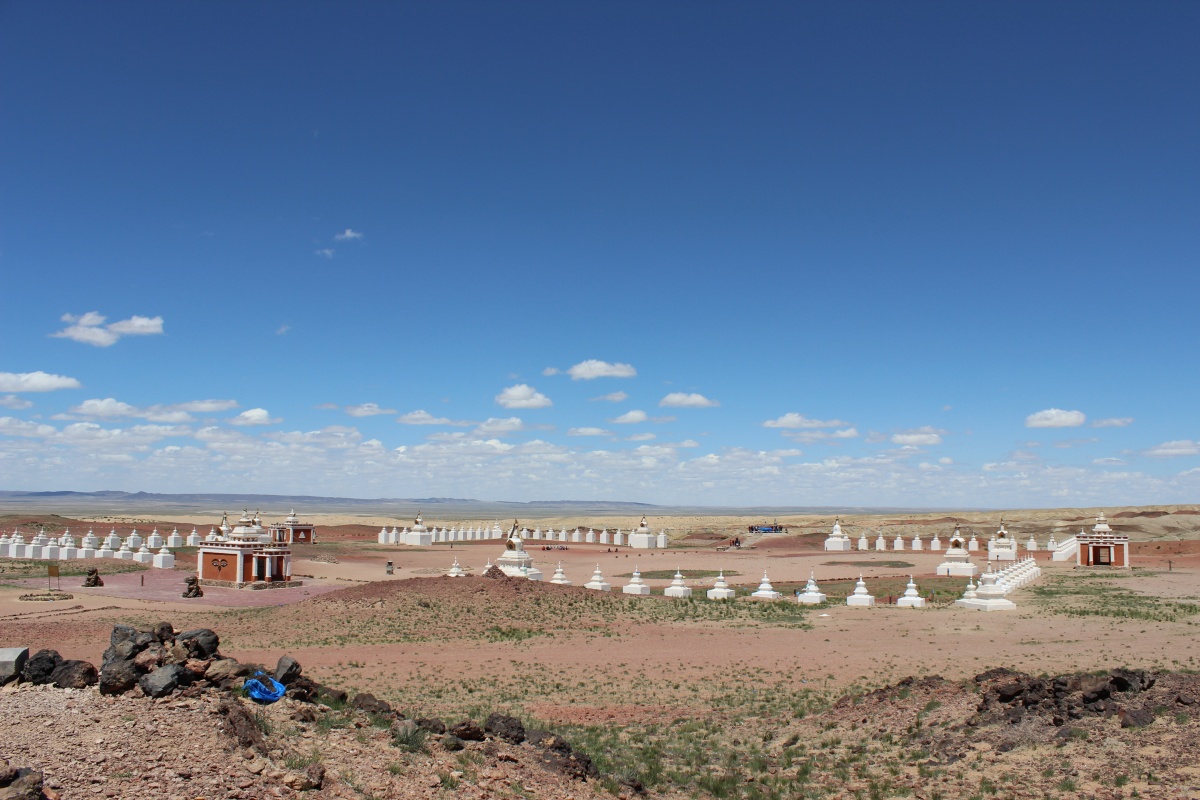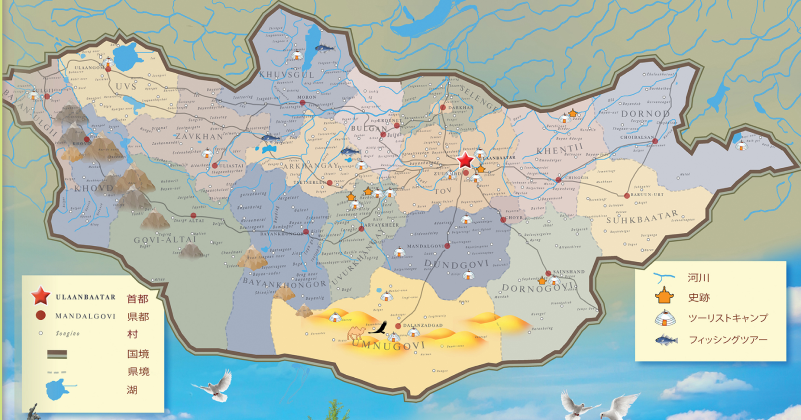
Khamar Monastery (Khamaryn Khiid) is one of the most historically and spiritually significant Buddhist sites in southeastern Mongolia. Located in Dornogovi Province, approximately 45 km south of the provincial capital Sainshand, the monastery lies within the dramatic landscape of the Gobi Desert.
The monastery was founded in 1820 by Danzanravjaa (1803–1856), a remarkable Mongolian Buddhist scholar, poet, writer, educator, and religious figure. He was known as the Fifth Noyon Khutagt of the Gobi, and his progressive approach to Buddhism and education made Khamar Monastery an important center of intellectual and cultural life in 19th-century Mongolia.
At its height, Khamar Monastery was not simply a place of worship. It developed into a large religious and educational complex containing numerous temples, stupas, residential quarters, and facilities for monks and pilgrims. It was also associated with schools dedicated to Buddhist philosophy, medicine, astrology, and traditional arts. Danzanravjaa encouraged education and artistic expression, and the monastery became an important center for literature, theater, music, and the preservation of Mongolian cultural traditions.
One of the monastery's most distinctive features was its connection with Danzanravjaa's cultural and theatrical activities. He established one of Mongolia's earliest organized theatrical traditions, known as the “Saran Khökhöö” theater. Performances combined Buddhist teachings, music, poetry, dance, and drama, making the monastery an important cultural institution as well as a religious one.
The monastery complex was severely affected during the religious purges of the 1930s, when Mongolia's Buddhist monasteries were systematically closed and destroyed. Many temples and religious artifacts were lost. However, a significant collection of Danzanravjaa's personal belongings, religious objects, manuscripts, artworks, and other cultural treasures was secretly preserved by local custodians. These surviving objects are now among the most valuable historical collections associated with Khamar Monastery and Danzanravjaa.
Today, the monastery has been restored and rebuilt, and it once again serves as an important pilgrimage destination. Visitors can explore its temples and surrounding sacred sites, learn about Danzanravjaa's life and philosophy, and experience the distinctive spiritual atmosphere of the Gobi.
Nearby is Shambhala, a sacred area traditionally associated with Danzanravjaa's spiritual teachings and his vision of a place where people could cultivate wisdom, compassion, and inner development. The surrounding landscape of open desert, rocky hills, and vast skies contributes greatly to the monastery's atmosphere and has made Khamar Monastery one of the most recognizable cultural destinations in the Gobi.
Khamar Monastery therefore represents much more than a historic Buddhist temple. It is a symbol of Mongolian Buddhism, education, literature, theater, art, and spiritual heritage. Its history reflects both the cultural achievements of 19th-century Mongolia and the profound changes that the country experienced during the 20th century. Today, Khamar Monastery remains an important place where Mongolia's religious and cultural traditions continue to be remembered and practiced.